Does Salon Workwear Pay for Itself? The Honest Math
What color day really costs you in ruined clothes, how to work out your own number, and when workwear is not worth buying.
By Comfort & Beauty Studio · 6 min read · 11/13/2026
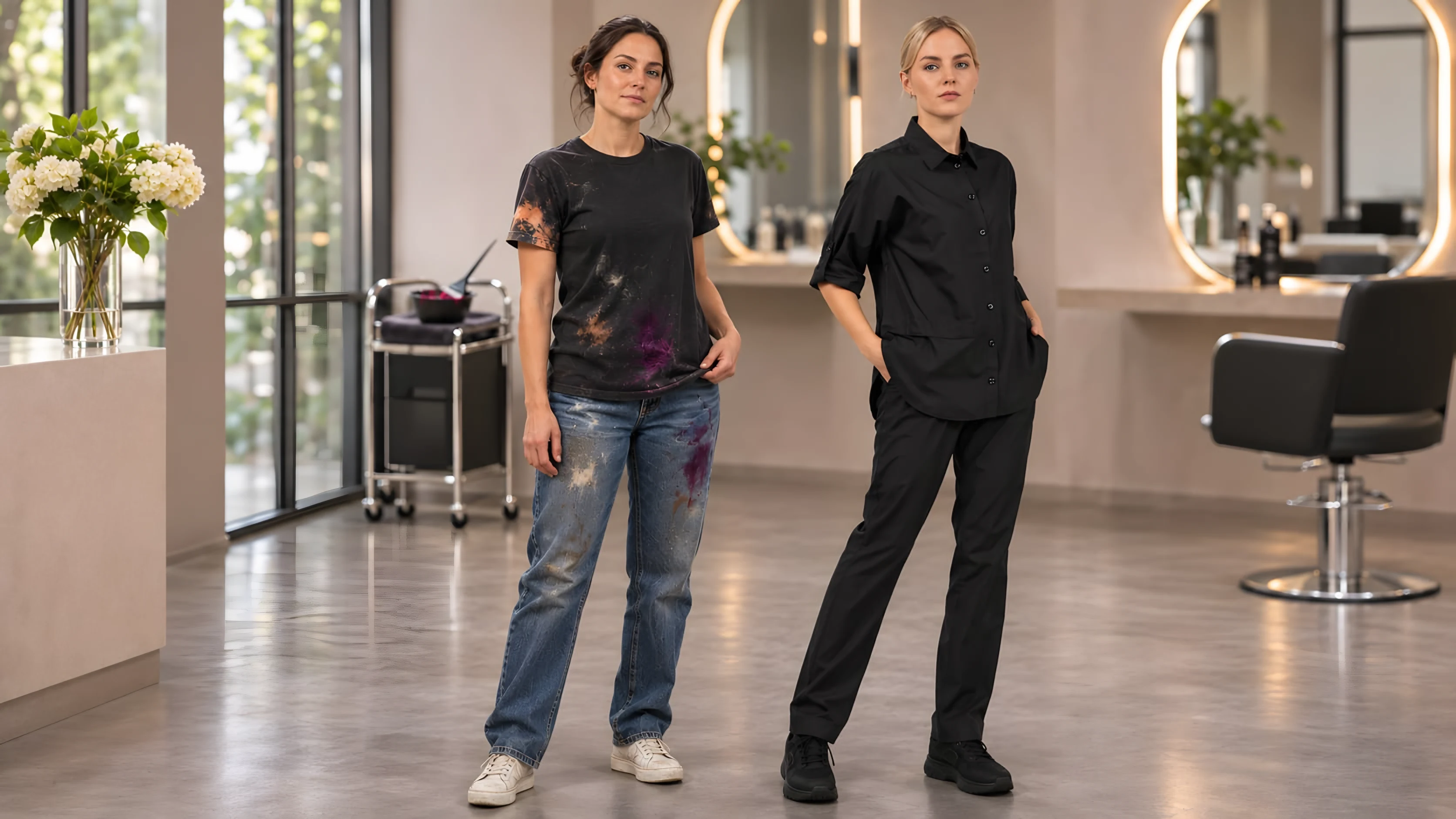
"Workwear that pays for itself" is our slogan, so you have every reason to be skeptical of it. Instead of asking you to trust us, here is how to check it against your own wardrobe.
Count what color day has already cost you
Open your wardrobe and pull out everything with a bleach spot, a dye mark or a faded patch you would not wear in front of a client. Most colorists find more than they expect: tops that became "salon only", then "home only", then cleaning rags. Put a rough price next to each one — what it would cost to replace today, not what you paid years ago.
Work out a year
Now estimate how many pieces you lose in a typical year. As an example, not an average: two tops at €35, one pair of black trousers at €60 and a pair of jeans at €80. That is €210 a year, every year — and it does not count the sweaters you stopped wearing to work because you were afraid for them.
Then compare that with a set made to resist dye, oxidants and bleach powder. A two-piece work suit in our collection costs around €150. If it takes the hits that used to land on your own clothes, it covers its price within the first year and keeps saving after that. Your number will be different — the point is to do the count with your own wardrobe.
The costs that never show on a receipt
Clothes are only the visible part. There is the time spent soaking, scrubbing and re-washing stains. The morning decision about what you can risk wearing today. The client who notices a bleached patch on your sleeve. None of it is on a receipt, but every stylist knows the feeling.
When workwear is not worth it
Honestly: if you mostly cut and style and rarely touch color, your clothes are not under the same attack, and a well-chosen everyday wardrobe may serve you fine. And if your salon already provides a uniform, buy only what fills a gap. Resistant workwear earns its price fastest for colorists, for anyone doing lightening work, and for stylists who wear their own clothes to the salon.
Make the math work
The calculation only holds if the set lasts. Wash at 40 °C or below, wipe splashes the same day, skip chlorine bleach and dry gently. Two pieces worn in rotation last much longer than one worn every day — and that is the cheapest way to make workwear pay for itself twice.