What to Wear as a Hairdresser: Notes From 30 Years Behind the Chair
Comfort for a ten-hour shift, fabric that survives color day, and a look that tells clients you take your craft seriously.
By Džiuljeta Vėbrė · 6 min read · 6/18/2026
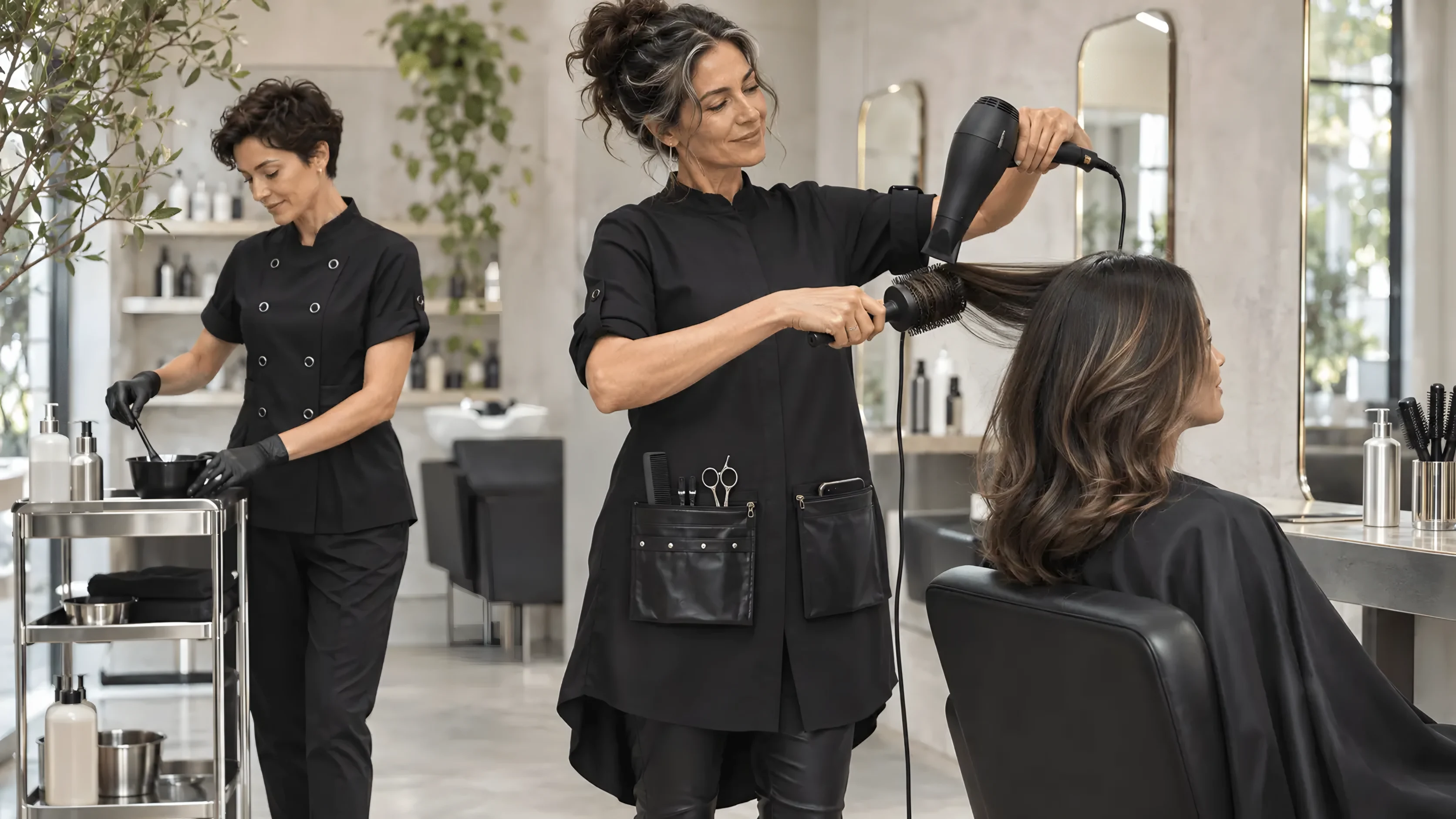
I have spent thirty years standing behind a chair, and I can tell you the honest truth: most of what stylists wear to work was never designed for the work. We borrow from streetwear, from office wardrobes, from whatever survived last month's color appointments. Then we act surprised when nothing survives this month's.
Start with the shift, not the outfit
A salon day is eight to ten hours on your feet, arms raised, moving between the chair, the basin and the mixing room. Whatever you wear has to move with your shoulders, breathe under hot lamps and blow-dryers, and still look composed at 7 p.m. That rules out anything stiff, anything that needs constant readjusting, and anything you'd cry over losing.
Respect the chemistry
If you work with color, your clothes work with color too. Dye mist settles where you can't see it, oxidant drips when you tilt a bowl, and bleach powder floats. Ordinary fabrics hold that pigment forever — one session can end a garment. This is why purpose-made workwear exists: fabric chosen so that dyes, oxidants and bleach powder don't claim it the way they claim your favourite black jeans. Wash it at 40 °C and it comes back ready.
Black is not boring — it is a uniform
Nearly everything we sew is black, and that is deliberate. Black hides the day, matches everything, and reads as professional in any salon interior. The interest comes from the cut: a bomber silhouette, a kimono sleeve, an eco-leather pocket. You can look like a stylist without looking like you're wearing a smock.
Pockets are a tool, not a detail
Count what you carry through one client: shears, clips, a tint brush, your phone, a comb. Now count how many times you put them down and lose them. Well-placed pockets — deep enough, angled for a working hand — save real minutes every hour. It's the part of workwear no one thinks about until they have it.
The economics
Here is the arithmetic that convinced me to start sewing workwear in the first place: a stylist who ruins even a few garments a year loses more money than a proper work set costs. Clothes that resist the chemistry pay for themselves — and then keep paying. That's not a slogan; it's the math on my own wardrobe over three decades.