Why Do Hairdressers Wear Black?
It hides the day — but that is only the start. Four practical reasons black became the salon uniform, and when it is worth breaking the rule.
By Džiuljeta Vėbrė · 5 min read · 11/13/2026
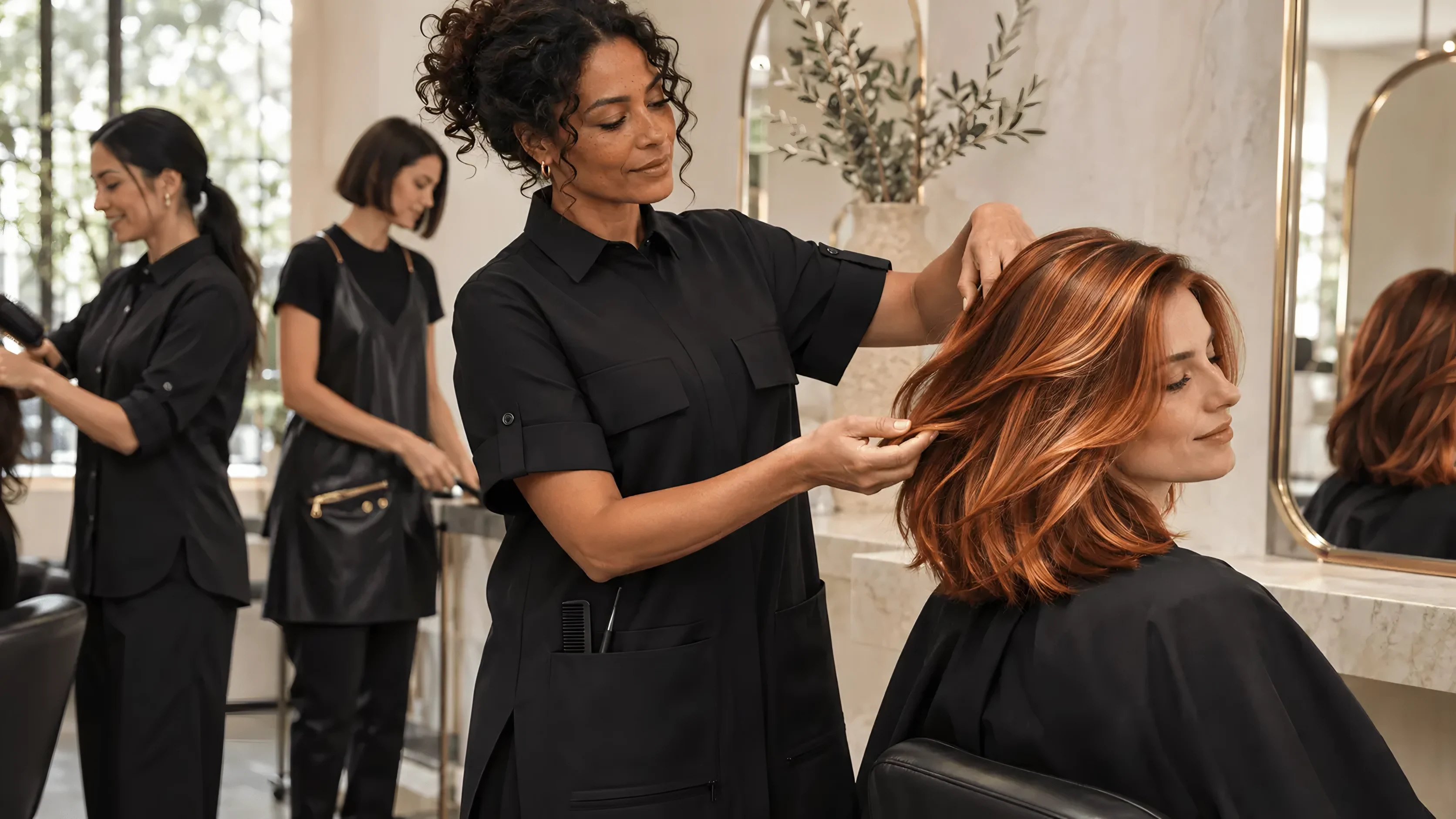
Clients ask me this more often than almost anything else. The short answer is "because it hides everything". The longer answer is more interesting, and it explains why nearly everything we sew is black.
It hides the day
Hair color travels: mist from a spray bottle, a drip from the bowl, a smear where you leaned against the trolley. On black fabric most dark tones simply disappear until the evening wash. On white or pastel fabric the whole day's work is written on you by lunchtime.
Black has one enemy, though: lightener. Bleach powder and oxidants do not add color, they take it away, and on ordinary black fabric they leave pale or orange patches that never come back. That is why resistance matters so much — black hides dye, but only resistant black also survives bleach.
It does not compete with the hair
Your client spends the appointment looking into the mirror, and you are in that mirror too. A dark, neutral background lets the color you have just created be the brightest thing in the frame. Patterns and strong colors pull the eye away from your work.
It makes a team look like a team
Black matches every interior, every season and every body. Ten stylists in ten different black pieces still read as one team, which is much harder with any other color. For a salon owner it is the easiest way to look consistent without putting everyone in identical clothes.
It looks composed at 7 p.m.
Clients trust a stylist who looks put together, and black is the easiest way to still look put together at the end of a ten-hour shift. It is quiet, it is professional, and it says the attention belongs to the client.
When to break the rule
Black is a convention, not a law. Some stylists prefer grey, navy or their salon's brand color, and with resistant fabric that can work too. What I would avoid for color work is anything light: it shows every mark and every faded spot. If you want individuality, put it in the cut — a kimono sleeve, a bomber silhouette, an eco-leather pocket — and let the color do its job.